Last month Ashley delivered workshops for clients to help with risk-based thinking and the topic of 5x5 matrices kept coming up. However, this assessment methodology constantly fails the TTM industry and its normally because the tool is misused and risks are not actually understood.
The 5×5 matrix looks simple: likelihood along the bottom, severity up the side, a score in the middle. Numbers in, number out. But a matrix is only as good as the thinking behind it, and two mistakes keep letting genuinely dangerous work look "acceptable" on paper:
The risk was never actually defined properly.
A control gets credited on both axes when it only ever touched one.
Mistake one: you can't score a risk you haven't defined
Most assessments start as a vague hazard: "traffic near workers" or "risk of vehicle incident." That's a topic, not a risk statement — and you can't honestly score likelihood or severity for a topic.
Take "a vehicle hits a pedestrian." How likely is that? You can't say, because it depends entirely on how it occurs. A driver could lose control, have a medical event, or simply not see them. A pedestrian might step out unexpectedly. Each has a different likelihood and severity. One vague statement covering all of them means your score is really a guess.
A proper risk statement fixes this with three specific parts:
Event – what happens (a pedestrian on the footpath is hit by a concrete truck entering site)
Cause – how it happens (the driver fails to see the pedestrian)
Consequence – the outcome (fatal injury)
Together: "A pedestrian on the footpath is hit by a concrete truck that is entering site as the driver fails to see the pedestrian, resulting in fatal injury."
Now the risk is understood, and the control is obvious: keep pedestrians and the truck apart. This is also what Temporary Traffic Management is really for — not signs and cones for their own sake, but managing the interaction between traffic and the works. A precise risk statement tells you exactly which interaction you're managing.
Mistake two: crediting one control on both axes
This is the trap that catches out even experienced people, because it makes a genuinely severe risk look acceptable without the site being any safer.
Scenario: Someone inspects a live carriageway. The risk is a worker being struck by a vehicle whose driver fails to see the worker, resulting in fatal injury. The control is a spotter, watching for traffic and calling a warning.
Ask two separate questions:
Does the spotter reduce likelihood? Yes - early warning gives a chance to step clear.
Does it reduce severity? No. A vehicle impact is still a vehicle impact.
The common mistake is dropping the score on both axes because "a control was added." A control only earns credit on the axis it actually changes.
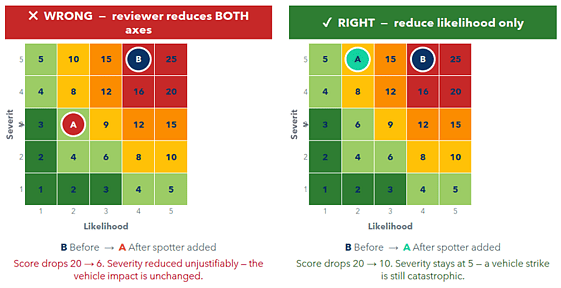
Here's why it matters. Many organisations state that any fatal outcome is "unacceptable," regardless of likelihood. But a pedestrian or worker struck above roughly 50 km/h has around a 90% chance of dying. On a 100 km/h road, the spotter never touches that severity — it's still there. By the organisation's own rule, that risk is still unacceptable. It's just that reducing the likelihood score alone made the total look fine on paper.
The risk of the works isn’t actually acceptable — the paperwork has just been optimistic.
This happens for two reasons:
A genuine misunderstanding of what the control does.
The culture within a business / organisation has been quietly shaped so workers can't say no — because if they did, some routine, necessary work couldn't continue as currently done.
It's an honest choice:
Accept the work can't continue as currently done and change how it's delivered. This requires a cultural shift and for business leaders to accept changes. This would mean a significant shake up to the industry, not necessarily a bad thing!
Review what is acceptable. Business leaders need to be honest about what is acceptable, maybe high severity but extremely low likelihood is acceptable. Now workers can be honest when doing risk assessments rather than ‘fudging’ scores. This doesn’t change the risk, but it does mean we become aware of these situations, allowing us to improve/eliminate them in the future.
What doesn't hold up is doing neither. This breeds a culture of ‘just get the work done’.
Three things worth reviewing
Beyond the formal process, there are three practical habits that catch what the paperwork sometimes misses:
Conflict points – where do people and traffic, or traffic and traffic, actually come close together? That's where things go wrong, and it's usually obvious once you look for it.
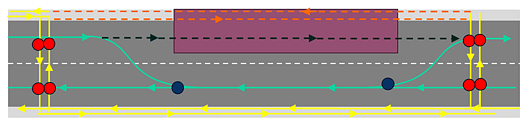
Near misses – These are second chances. If something almost went wrong, the system has already told you where it's weak. But we need to identify what could have happened. Act quickly to prevent it from happening for real.
Gut feel – Workers generally have a higher tolerance of risk than the system does. Therefore, if something feels off on site, it almost certainly is. Trust the gut feel and check what's triggering it.
Summary
A matrix is only as honest as what goes into it, and often we are not very honest!
Write a specific risk statement, event-cause-consequence, so you can properly review the risks.
Test controls to see if they change the likelihood, severity or both. Don’t assume both.
Stop ‘fudging’ the numbers to get too acceptable, controls need to actually make the risk acceptable.
Be genuine about what is acceptable to allow a culture of genuine risk assessment.